
Stair nosing guide
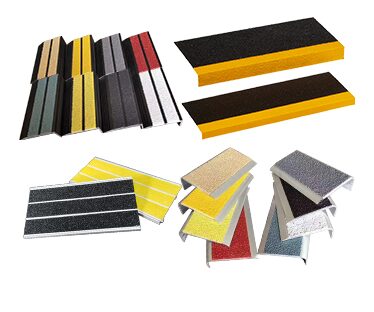
Step edges are where most stair slips start. A stair nosing protects the edge, adds grip and makes each step easier to see. This guide covers the main types and how to specify them.
What is a stair nosing?
A stair nosing is a profile fixed to the front edge of a step. It protects the edge from chipping and wear, provides an anti-slip surface where the foot lands, and creates visual contrast so the edge is easier to see.
Aluminum nosings with carborundum inserts
Aluminum profiles with carborundum (silicon carbide) inserts are the most durable choice for commercial, industrial and public buildings. Profiles include L-shaped corner-wrapped nosings such as the H-024, curved profiles such as the YM-11 and HJLY-1944, and flat profiles such as the TH-1535. Finishes include mill finish, clear or black anodized aluminum, and galvanized steel.
Fiberglass (GRP) stair treads and nosings
Fiberglass stair treads and nosings have a gritted surface bonded to glass-reinforced plastic. They do not rust or rot, so they are well suited to outdoor stairs, walkways, ladders and wet or industrial environments, and they can be fitted over existing timber, concrete or steel steps.
Luminous stair nosings
Luminous stair nosings combine an anti-slip surface with photoluminescent strips, so the edge of each step remains visible in darkness or a power failure. Learn more in how glow in the dark tape works.
Choosing the grit grade
- Super Coarse (H-10) and Extra Coarse (G-20) — outdoor and heavy industrial stairs
- Coarse (G-40) — general commercial and public stairs
- Fine (G-60), Extra Fine (G-80) and Super Fine (G-100) — interiors where a finer finish is preferred
What to include in a specification
- Profile type and dimensions (width, height, length)
- Material and finish
- Insert color and grit grade
- Substrate (concrete, timber, steel, tiles) and fixing method
- Indoor or outdoor use and any glow-in-the-dark requirement